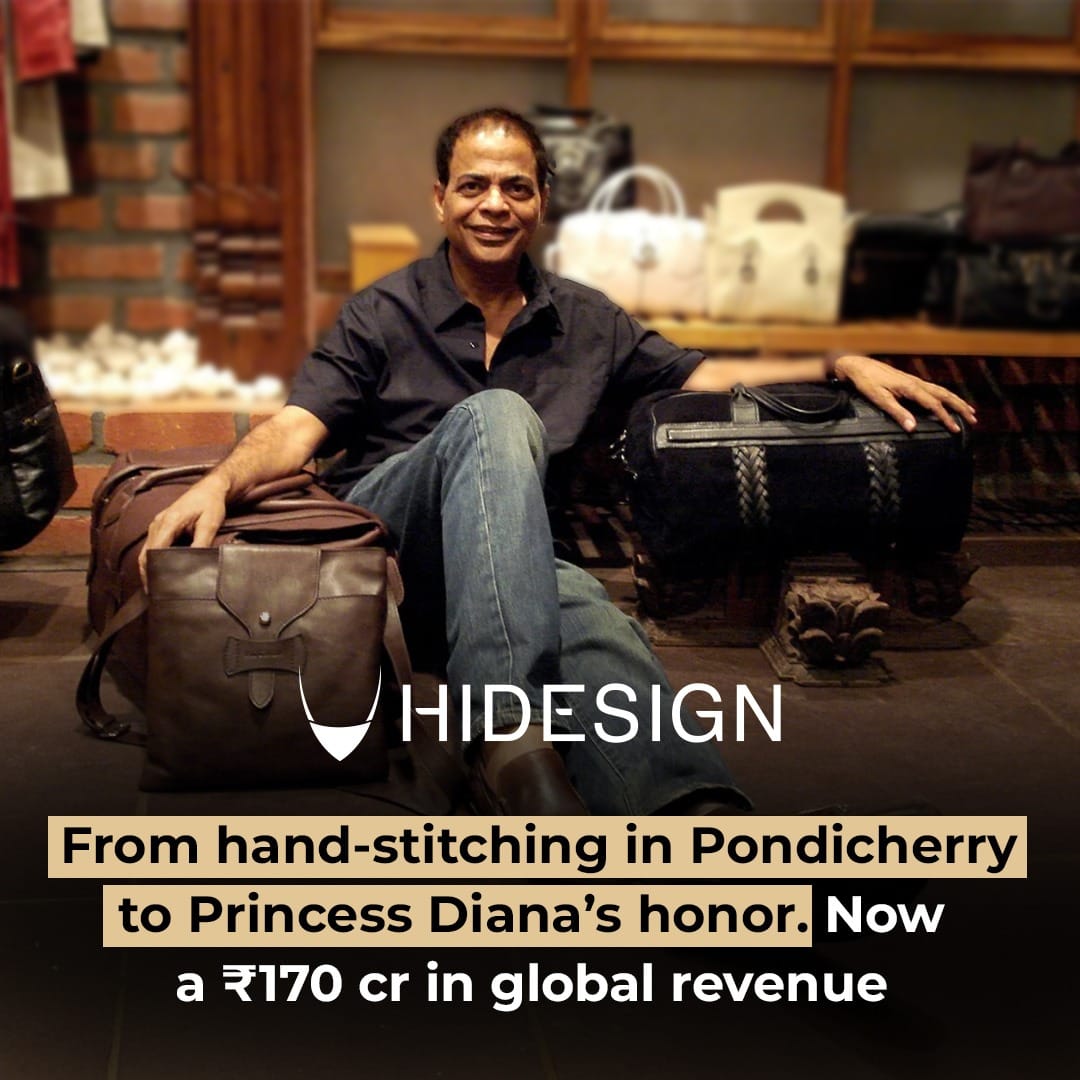
Handcrafted by the founder, delivered on a scooter in Pondicherry — now a ₹188 crore global brand.
🌱 A Seed That Started Far From Home
In 1970, a young Pondicherry student, Dilip Kapur, left India for the U.S., where he studied, worked in leather factories, and travelled through Europe ✈️.
With every place he visited, he picked up something new — hand-tanning, natural dyes, vegetable tanning, and slow artisanal craft — and looking back now, these were the skills that shaped everything that followed.
And through all this learning, one truth stayed stubbornly clear:
India made world-class leather, but it never made luxury.
India exported raw material while foreign brands added value, prestige, and took the credit.
It was the kind of realisation that quietly sits in your mind, waiting to become a reason.
🧵 A Garage That Became a Vision
When he returned to Pondicherry in 1978, bag-making was still just a hobby.
He stitched three bags for his mom, sister, and aunt, never thinking much of it — until a friend bought one for ₹300.And that small moment, simple as it was, felt like the first nudge toward something bigger.
So with ₹25,000, a cobbler, a tiny garage, two artisans, a few hand tools, and vegetable-tanned leather, he began what would become Hidesign.
He cut patterns, finished edges, stitched samples, and delivered every piece on his scooter 🛵. Life moved slowly then, but in hindsight, slowness was his biggest advantage.
There was no profit, only patience — but sometimes patience is the only capital a founder truly needs.
Then in 1982, Western boutique buyers visiting India noticed the smell, raw texture, and hand-stitched edges. They placed small orders for the U.K., Germany, and Australia, and kept returning because the craft felt honest.
As they shared it with other stores, it became clearer that authenticity doesn’t need advertising — it just needs one believer to start the ripple.
🌍 When Word of Mouth Became Momentum
While the world leaned into mass production, Hidesign’s handmade purity quietly travelled through boutiques in Europe, Australia, Singapore, and Hong Kong.
No ads, no campaigns — just people talking. And that is often how real brands grow slowly, naturally, and with the weight of genuine appreciation.
Demand soon outpaced the number of trained artisans. It showed that the product itself had become the marketing. And as many founders later realise, growth often demands the same thing craft does — more hands, not more shortcuts.
🏬 Early 1990s — Scaling While Keeping the Soul Intact
Global demand moved Hidesign into premium stores in London, Amsterdam, Singapore, Hong Kong, and Germany, and the garage finally fell short of its own growth.
Production shifted to larger Pondicherry units, but even in that scaling, the brand held onto its values — adding only basic machines and keeping hand-tanning untouched.
Early artisans became trainers, and this passing of skill was more than growth — it was legacy forming itself quietly.
India soon noticed. Stores opened in Chennai, Bengaluru, Delhi, Mumbai, and Hyderabad, and for the first time, the country saw a luxury brand that didn’t arrive stamped with a foreign name.
When the “Boxy Bag” won Accessory of the Year in 1992, presented by Princess Diana, it felt like the world finally said out loud what the craft had been saying silently for years.
Recognition, as many learn, can move trust faster than marketing ever will.
👜 Growth That Protected Identity
As retail grew, Hidesign expanded into Lifestyle, Shoppers Stop, Central, and duty-free stores, adding categories like women’s handbags, laptop bags, business cases, and accessories.
Machine-made competitors grew cheaper and faster, but Hidesign held its own by staying rooted in natural dyes, hand-cut leather, brass hardware, and minimal design. And sometimes, standing still in your values is the boldest form of progress.
🏭 Scaling With Heritage at the Center
Demand pushed the brand to add units in Sikkim and Sri Lanka, but all design and high-skill craft remained in Pondicherry — a quiet reminder that you can outsource space, but not soul.
By 2010, Hidesign had become India’s largest premium leather brand, present in 25+ countries, with 90+ stores and 200+ retail points.
Collections like Atelier, Earth, the vegetable-tanned line, and classic briefcases gave the brand a signature of its own.
The four-storey Pondicherry flagship — with its café and museum-style craft display — wasn’t just a store. It was a statement: heritage and luxury are not opposites; they are reflections of each other.
With confidence came eyewear, footwear, and travel accessories — each built with the same craft-first discipline. And through this phase, the brand learned what many great houses learn — growth only strengthens your identity when your identity leads the growth.
💻 When Luxury Learned to Live Online
Hidesign entered the digital era through Hidesign.com, curated drops, exclusive online collections, and partnerships with Myntra, Amazon, and Ajio.
Luxury is a touch-and-feel world, and going online felt risky — yet storytelling, transparency, and loyal customers transformed digital into a new growth engine.
It became clear that people don’t just buy products; they buy the truth behind them.
🌿 Reinvention Without Losing Roots
During the pandemic, online sales became the brand’s lifeline.
This led to a reinvention — minimal designs, sustainable leather, digital-first launches, and global collaborations.
The challenge was evolving without losing heritage, but Hidesign chose to evolve its craft instead of replacing it, keeping the Pondicherry soul at the center.
And somewhere in this shift, a familiar truth resurfaced: reinvention works only when the roots still show.
🌎 Hidesign Today
Hidesign today stands as:
• In 25+ countries
• 90+ stores
• A ₹170–200 crore handcrafted leather brand
From a tiny Pondicherry garage to global luxury, the craft never changed.
Because true luxury is built by hands — not hype.
💡 Built to Grow, Not Break
Hidesign kept growing because:
· Craft stayed pure.
· Handwork shaped identity.
· Veg-tanned leather built its soul.
· Global trust came early.
· Retail + D2C scaled it.
· Reinvention kept it relevant.